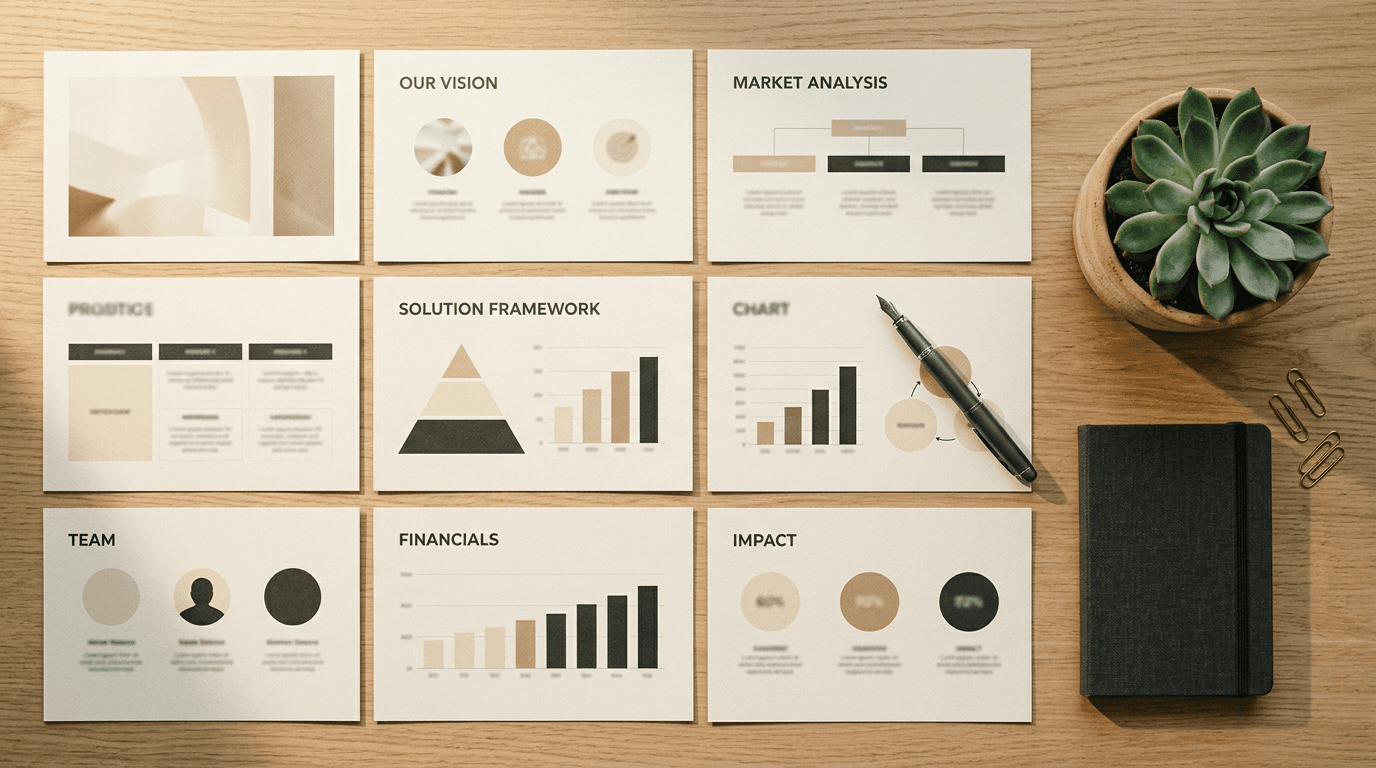
Investors see hundreds of decks a month. Most get 30 seconds before being closed. The ones that earn a second look share the same structural discipline — they answer the right questions in the right order, before the investor even thinks to ask them.
This guide covers what makes a pitch deck actually work, slide by slide. Not the generic advice you've read everywhere else, but the specific mistakes that kill deals and the specific moves that create momentum.
The job of a pitch deck
A pitch deck does one thing: earn a meeting. It does not close a round. It does not replace a conversation. Its only goal is to make an investor curious enough to reply to your email.
That changes how you should write it. Every slide should create a question the investor wants to ask — not answer every question they could possibly have. The founder who understands this writes a deck that's 12 slides and a pleasure to read. The founder who doesn't writes a 40-slide thesis that nobody finishes.
Before you open a slide tool, write one sentence that captures your company: We help [customer] solve [problem] by doing [thing], and we have [evidence it works]. If you can't write that sentence cleanly, the deck isn't your problem yet.
The 10 slides every investor-ready deck needs
1. Problem
Open with the problem, not your company. Make the investor feel the pain before you introduce the solution. One sharp, specific problem statement beats a paragraph of market context.
The goal is empathy. An investor who understands why the problem matters will be patient through your solution, your market sizing, and your ask. An investor who doesn't feel the problem by slide two is already skeptical.
What investors look for: Is this a real problem? Do real people feel it acutely? Is it large enough to matter at scale?
Common mistake: Starting with "We are [Company Name], building [thing]." Nobody cares yet. You haven't earned the right to introduce yourself.
Better approach: Open with a specific customer scenario. "Every month, a mid-market logistics company loses $40K to invoice reconciliation errors that a $20/month spreadsheet created — and they won't know until the audit." Now you have their attention.
2. Solution
Explain what you've built in one or two sentences. Show, don't tell — a product screenshot or a before/after diagram is worth more than three paragraphs of description.
Your solution slide should answer exactly one question: how does this remove the pain from the problem slide? If you're adding context about the technology, the roadmap, or the team, you've drifted.
What investors look for: Is this the right solution to the stated problem? Is it elegant or is it a workaround that creates new complexity?
Common mistake: Over-explaining features instead of showing the customer outcome. The investor doesn't care that you have 47 integrations — they care that your customer's problem went away.
3. Why now
Markets have windows. Something changed — regulation, technology, infrastructure, or consumer behavior — that makes this the right moment for your company to exist. Investors fund timing as much as they fund ideas.
This slide is often skipped, which is a serious mistake. "Why now" is actually "why didn't someone build this five years ago, and why will someone build it if you don't?" If you can't answer that, the investor will ask it in the first meeting — or they won't bother to have one.
What investors look for: Is there a genuine inflection point that creates urgency? Regulatory tailwinds, a new API or infrastructure layer, a behavioral shift post-pandemic — these are real catalysts.
Common mistake: Writing "the market is growing" as your why-now. Markets have been growing for decades. That's not timing — that's a background fact.
4. Market size
TAM, SAM, SOM — but done with actual math. Bottom-up numbers beat top-down percentages. "We're going after 3% of a $200B market" is weak because every investor knows it's reverse-engineered from a target rather than built from reality.
Here's a credible approach: "There are 180,000 mid-market logistics companies in the US. The average company spends $1,200/year on the manual process we're replacing. That's a $216M SAM in the US alone." This works because it names the customer, names the behavior, and arrives at a number the investor can interrogate.
What investors look for: Is this big enough to build a venture-scale business? Is the math defensible — can they poke at the assumptions without the number collapsing?
Common mistake: Citing a Gartner report and claiming 1% of a $50B market. Every investor has seen this. It communicates nothing.
5. Product
Go deeper here if you skipped visuals on the Solution slide. Show the product working. Screenshots, a demo video linked in the deck, or a walkthrough of the core user journey all work. The bar is simple: by the end of this slide, the investor should have no doubt that the product exists and works.
If you're pre-product, show mockups — but label them as mockups. Trying to pass a prototype as a production product will end the conversation when it's discovered in diligence.
What investors look for: Does this product actually exist? Is the UX thoughtful enough to suggest the team has spoken to users?
6. Traction
Numbers are credibility. ARR, MRR, DAUs, weekly active users, retention cohorts, NPS, growth rate — whatever is most meaningful for your stage. If you're pre-revenue, show other proof: waitlist conversion rates, LOIs, pilot agreements, activation metrics.
The shape of traction matters as much as the level. Flat revenue with one large customer is lower signal than growing revenue with ten small ones. Monthly cohorts that retain at 80% after six months are more valuable than impressive top-line numbers with hidden churn.
What investors look for: Is there signal of product-market fit? Is growth organic (better) or entirely paid (weaker)? Does the team know which metrics actually matter for their business?
Common mistake: Hiding weak metrics behind relative percentages ("300% growth!") without showing the absolute numbers. Investors will ask. If the answer is "we grew from $3K to $12K MRR," the framing damage is already done.
7. Business model
How do you make money? Per seat, usage-based, marketplace take rate, transaction fee, enterprise contract? Keep it simple. Include your current pricing if you have it — it signals that you've tested the market.
The most important question here is unit economics, even at an early stage. If you don't yet know your CAC or LTV, be honest about that and explain what you expect them to look like and why. A founder who has thought carefully about the economics — even imperfectly — is more fundable than one who defers the question.
What investors look for: Is the unit economics defensible as the company scales? Does the model align with how customers actually get value?
8. Team
Why are you the team to build this? Specific past wins beat logos and school names. "Ex-Google" means little without context. "Built and scaled the logistics API at Flexport from 0 to 400 enterprise customers in two years" means a lot.
Answer three questions on this slide: Why are you uniquely qualified for this problem? Have you built and shipped together before? Are the roles clearly divided so you can make decisions without constant alignment?
What investors look for: Domain expertise, evidence of execution at some scale, cofounder complementarity. They're also reading between the lines for founding team stability — ambiguous roles and vague histories are yellow flags.
Common mistake: Listing every advisor with a headshot. Advisors are not operators. If your team slide is mostly advisors, investors will wonder who's actually building the company.
9. Competition
Do not write "No direct competitors." Every investor knows better, and you've just lost credibility in the most important meeting you'll have this year. Show the competitive landscape honestly and explain your differentiated position with specificity.
A 2×2 matrix can work if the axes are meaningful — dimensions that investors can verify and that customers actually use to make decisions. "Fast vs. slow" and "cheap vs. expensive" are meaningless. "API-first vs. monolithic" and "self-serve onboarding vs. implementation required" can be meaningful if they align with what your customers actually care about.
What investors look for: Does this founder understand the competitive landscape? Is the moat real — is the company winning because of something structural, or because they got there first?
Common mistake: A competitive slide that only names one competitor and declares victory. Name the whole landscape — direct, indirect, and "do nothing."
10. The ask
State the amount, the use of proceeds, and the key milestones the round enables. Be specific. "We're raising $2M to hire three engineers and one sales rep, extend our runway to 18 months, and reach $500K ARR — the threshold we expect will open a Series A" is a clear ask. "We're raising to grow the team and accelerate growth" is not.
Investors want to know what success looks like at the end of this round and why the ask is sized correctly to get there. The use-of-funds breakdown doesn't need to be a spreadsheet, but it should demonstrate that you've thought carefully about the sequencing.
What investors look for: Does the ask match the stage? Is the milestone ambitious enough to matter but credible enough to believe?
The five slides founders almost always get wrong
1. Market size with top-down math. Investors discount percentage-of-TAM claims automatically. Build the number from the bottom up, starting with the customer you're actually targeting.
2. A team slide that's all logos. Past employers and schools matter less than specific wins. Cut the logos and write one precise sentence per founder about your most relevant evidence of capability.
3. Solution before problem. You've lost the investor's empathy before you've earned it. Problem first, always. The audience needs to care about the problem before they can evaluate your solution.
4. No traction slide. If you have anything — pilot customers, LOIs, waitlist sign-ups, activation data, even strong qualitative feedback from design partners — show it. The absence of a traction slide reads as: there is no traction worth showing.
5. A 40-slide deck. Target 12–15 slides. Everything else belongs in an appendix that you can pull from when the investor asks a specific question in the meeting. A long deck signals poor judgment about what matters most — which is itself information.
How to structure your narrative
The best decks follow a simple through-line:
The world has this problem → we built this solution → it works (traction) → the market is large → our team is uniquely positioned to win it → here's what we need to get there.
Every slide should be one beat in that story. If a slide makes an investor ask "why is this here?" — cut it or fold it into a slide that's already earning its place.
A useful test: cover up your company name and logo and give the deck to someone unfamiliar with your business. Can they reconstruct the story? Can they explain what you do and why it matters? If not, the narrative work isn't done yet.
What to do before you send your deck
Before your deck lands in an investor's inbox, run it through an objective lens. Ask a peer who's been through a raise to read it and tell you what's unclear. Get a second opinion on your market sizing math. Make sure the traction slide shows the most compelling metric — not just the easiest one to display.
You can also run it through a free AI pitch deck analyzer that scores your deck across 8 investor criteria in two minutes. PitchVault gives you a VaultScore™ out of 100, flags structural gaps, and provides slide-by-slide feedback on what's landing and what's not.
The goal isn't a perfect deck — it's a deck that earns a conversation. Analyze your deck free →